The 5 Types of Acne Explained: Which One Do You Have?
Most people have more than one type at once, which is why a single product rarely clears everything. Effective care matches the right approach to the right type.
4/19/20265 min read
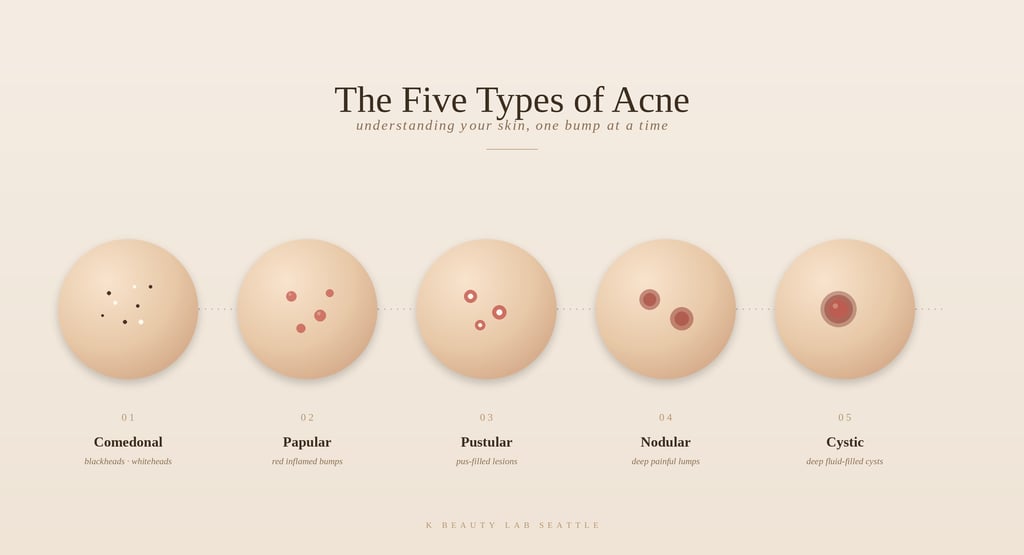
There are five main types of acne — comedonal (blackheads and whiteheads), papular (red inflamed bumps), pustular (whiteheads with pus), nodular (deep painful lumps), and cystic (deep fluid-filled cysts). Most people have more than one type at once, which is why a single product rarely clears everything. Effective care matches the right approach to the right type.
If you have ever wondered why one product clears your skin for a week and then stops working, or why your chin keeps breaking out no matter what you do, the answer is usually the same: you are dealing with more than one type of acne at the same time.
At K Beauty Lab Seattle, we build every plan around identifying exactly what type (or types) of acne you have, so you are not wasting money on products and services that were not designed for your breakout pattern. Here is what to look for.
1. Comedonal Acne (Non-Inflammatory)
Quick answer: Comedonal acne is non-inflammatory acne caused by pores clogged with oil and dead skin. It appears as blackheads (open comedones) or whiteheads (closed comedones), is not red or painful, and shows up most on the forehead, nose, chin, and sides of the cheeks.
Whiteheads are closed comedones — pores clogged with oil and dead skin cells, sealed at the surface.
Blackheads are open comedones — pores open to the air, so the trapped oil oxidizes and turns dark.
Why it matters: Comedonal acne is the foundation of almost every future breakout. Clearing comedones early helps prevent the inflamed breakouts that come later.
2. Papular Acne (Inflammatory)
Quick answer: Papular acne is small, red, inflamed bumps without visible pus. It signals that inflammation has begun inside the pore and often progresses to pustules or cysts if left unaddressed.
Papules are tender to the touch, indicate early inflammation, and are the best stage to address. Catching papular acne before it progresses is the difference between a short flare and a months-long breakout.
3. Pustular Acne (Inflammatory)
Quick answer: Pustular acne is an inflamed lesion with a visible white or yellow pus center. It is what most people picture as a pimple. Improper extraction at home is one of the leading causes of post-acne marks and scars.
Important: Squeezing pustules, especially for people with deeper skin tones, dramatically increases the risk of post-inflammatory hyperpigmentation (PIH) and long-lasting dark marks.
4. Nodular Acne (Severe Inflammatory)
Quick answer: Nodular acne is a large, firm, painful lesion that forms deep beneath the surface of the skin. Nodules do not come to a head, can last weeks, and have a high risk of permanent scarring without professional support.
Nodular acne rarely clears with over-the-counter products alone. This is the stage where professional care makes the biggest difference.
5. Cystic Acne (Severe Inflammatory)
Quick answer: Cystic acne is the most severe form of acne, characterized by deep, painful, fluid-filled cysts that are often recurrent and almost always leave marks or scars if left unaddressed. It is frequently hormonal, appears along the jawline and chin, and flares with cycles and stress.
If you have been dealing with cysts for more than a few months, at-home products alone will not solve it.
Acne Classified by Cause
Identifying the visual type is only half the picture. The cause matters just as much.
Hormonal acne: Jawline and chin breakouts that flare with your cycle or hormonal shifts.
Stress-related acne: Triggered by cortisol, common in the fast-paced Seattle tech and healthcare workforce.
Acne mechanica: Caused by friction and pressure — masks, helmets, backpack straps, rainy-day hoods.
Acne cosmetica: Triggered by comedogenic skincare or makeup, including heavy SPFs.
Post-inflammatory hyperpigmentation (PIH): Dark marks left after acne heals, not acne itself.
Why Generic Acne Products Do Not Work
Direct answer: Acne products designed for one type of acne can actively worsen another. Benzoyl peroxide may calm a pustule but dry out the skin and trigger more comedones. A strong retinoid may help with blackheads but inflame active pustular skin and worsen PIH. A personalized plan matches each layer of the problem to the right approach.
This is where a Korean skincare approach stands out. K-beauty routines prioritize barrier support and layered, targeted care rather than a single aggressive hero product — which is why they tend to work well for multi-type acne.
Recommended Services at K Beauty Lab Seattle
Depending on what your skin needs, here is how we approach it at our skincare studio.
Cold Plasma — Best for Active, Inflamed Acne
For papular or pustular breakouts, or acne that is actively red, angry, and spreading, Cold Plasma is often where we start. Cold plasma energy helps eliminate acne-causing bacteria on the surface of the skin, reduce redness, and calm inflammation. It is gentle and safe for sensitive skin.
Book appointment for Cold Plasma
Potenza RF Microneedling — Best for Recurring Acne and Acne Marks
For nodular, cystic, hormonal, or recurring acne, Potenza goes deeper. Microneedles combined with radiofrequency energy help regulate oil production at the source, stimulate collagen to soften post-acne texture, and improve the appearance of scars. This is the service most clients ask about when their acne keeps coming back.
Book appointment for Potenza RF Microneedling
Pico Laser — Best for Acne Marks and Pigmentation
If your active breakouts are under control but you are left with dark marks, red marks, or uneven tone, Pico Laser targets pigmentation precisely without affecting surrounding skin.
Book appointment for Pico Laser
Quick guide: Cold Plasma calms and clears. Potenza addresses the root cause. Pico targets the marks left behind.
Most clients benefit from a combined plan, sequenced in the right order for their skin.
Frequently Asked Questions
What are the 5 types of acne?
The five main types of acne are comedonal (blackheads and whiteheads), papular (red inflamed bumps), pustular (pus-filled lesions), nodular (deep painful lumps), and cystic (deep fluid-filled cysts). Most people have more than one type at the same time, which is why one product rarely clears everything.
How do I know what type of acne I have?
Look at your breakouts. Small non-red bumps are comedonal. Red bumps with no pus are papular. Red bumps with visible pus are pustular. Deep, painful, firm lumps are nodular. Deep, fluid-filled, recurring lesions are cystic. Most people have a combination, and a professional skin analysis confirms the mix.
What is the best approach for cystic acne in Seattle?
For active cystic acne, the most effective approach is a combined plan: Cold Plasma to calm inflammation and reduce bacteria, Potenza RF Microneedling to address the underlying oil production and post-acne texture, and a hormonal-acne-appropriate Korean skincare home routine.
Is hormonal acne its own type?
Hormonal acne is classified by cause rather than type. The actual lesions are usually cystic, nodular, or papular. What makes it hormonal is the pattern — recurring breakouts along the jawline and chin that flare with menstrual cycles, stress, or hormonal shifts.
How long does a professional acne plan take to work?
Most clients see visible improvement within 2 to 4 weeks of starting a professional plan, with fuller clearance across a 3-month series. Correcting your home routine at the same time speeds results significantly.
Can I get a K-beauty facial with active acne?
Yes, but the approach has to match the state of your skin. Aggressive facials and extractions during active inflammatory acne can worsen scarring. At K Beauty Lab Seattle, our acne-focused services are designed specifically for active, reactive skin.
Not all acne is the same, and treating it like it is wastes time, money, and skin. Whether you are dealing with stubborn blackheads, painful cysts, or dark marks that will not fade, the first step is identifying exactly what type of acne you have.
Book a skin analysis at K Beauty Lab Seattle and get a Korean skincare plan tailored to your exact acne type. Serving Seattle, Northgate, Bothell, Kirkland, Bellevue, Redmond, and the greater Eastside.
Contact
Get in touch with us for more information.
NEW Hours
NEW Location
10am to 6:45pm
1pm to 8:30pm
10am to 6:45pm
Closed
© 2026 K Beauty Lab. All rights reserved. | Crafted with care in Seattle.
Email: info@kbeautylabseattle.com
Phone: 206-999-6524
10564 5th Ave NE
Unit 201
Seattle, WA 98125

Popular Services
Quick Links
K Beauty Lab
Authentic Korean beauty treatments in the heart of Seattle. Experience the art of radiant skin.
Follow us on Instagram for the latest deals and promotions.
Seattle, WA
Mon / Tue :
Wed / Thur :
Fri / Sat :
Sunday :